- 24 December, 2025

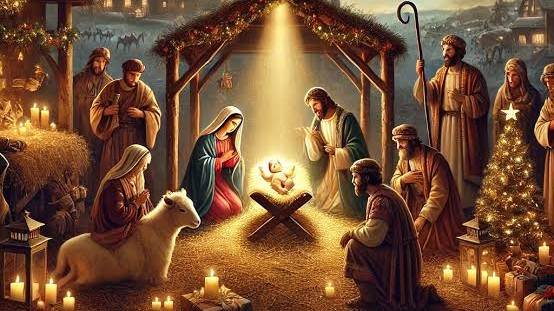
Goa, December 24, 2025: Christmas celebrates not merely an event in history, but the heart of the Christian faith: the mystery of the Incarnation. At Bethlehem, God entered human history, not with power or spectacle, but in humility—born as a child, laid in a manger.

The Birth Narratives: Different Perspectives, One Mystery
The Gospels according to St. Luke and St. Matthew narrate the historical circumstances surrounding the birth of Jesus.





• St. Luke (Lk 2:1–20) presents a poor and simple setting: Mary and Joseph, a manger, shepherds watching by night. The Good News is first announced to shepherds—people on the margins—signifying that salvation is offered to all.
• St. Matthew (Mt 1:18–25; 2:1–12) emphasizes God’s fidelity to His promises, highlighting Joseph’s obedience and the visit of the Magi, who represent the nations of the world.
In contrast, St. John does not describe the manger or angels. Instead, he takes us deeper, beyond time itself:
“In the beginning was the Word, and the Word was with God, and the Word was God… And the Word became flesh and dwelt among us” (Jn 1:1,14).
John presents Christmas not as a scene, but as a theological proclamation: the eternal Son of God truly became human.
The Angelus: Proclaiming the Mystery of the Incarnation
This profound truth is echoed daily in the Angelus prayer: “And the Word was made flesh, and dwelt among us.”
Each time we pray the Angelus, we proclaim the Christmas mystery: God became man. Jesus Christ is not half-God or half-man; He is true God and true man, united in one Person.
This belief stands at the core of Christian faith.
Defending the Truth: Against False Understandings of Christ
Early Christian history witnessed serious misunderstandings about Jesus:
• Arianism claimed that Jesus was not truly God, but a superior creature.
• Docetism argued that Jesus only appeared to be human and did not truly share our flesh.
St. John firmly rejects both errors by insisting that “the Word became flesh”. God did not merely visit humanity; He fully entered into it—sharing our joys, struggles, suffering, and even death.
Christ’s Humility: The Heart of Christmas
St. Paul captures this mystery beautifully in his hymn to Christ:
“Though he was in the form of God, he did not regard equality with God as something to be grasped, but emptied himself humbling himself and becoming obedient unto death” (Phil 2:6–8).
Unlike Adam and Eve, who desired to be like God, Jesus—who truly was God—chose humility. Because of this self-emptying love, God exalted Him (Phil 2:9–11). Christmas thus reveals that true greatness lies in humility.
Who Came to Worship Him?
The birth of Jesus draws together the entire human family:
• Shepherds—the poor and socially insignificant—came with haste after hearing the angel’s message (Lk 2:16–20).
• The Magi—wise men from distant lands—represent the nations and the learned.
The manger becomes a meeting place where rich and poor, local and foreign, simple and wise stand together before the same Lord.
The Manger: A Theological Sign
St. Augustine offers a striking insight:
“He was laid in a manger, He became our food.”
The One born in Bethlehem—the “house of bread”—would one day give Himself as the Bread of Life. Christmas already points toward the Eucharist, where Christ continues to nourish and strengthen His people.
What Does the Birth of Jesus Teach Us Today?
1. Humility and Detachment
Jesus chose poverty and simplicity. Christmas challenges our attachment to comfort, status, and possessions, inviting us to embrace humility.
2. Unity and Inclusion
The birth of Christ brings together shepherds and wise men. It urges us to reflect: How do we look at the poor, migrants, and those on the margins of our society?
3. Strength through His Presence
Christ did not remain distant. In the Eucharist, He continues to give us His Body and Blood, strengthening us for life’s struggles.
4. Mission and Witness
The shepherds, after seeing Jesus, returned glorifying God and proclaiming what they had heard and seen. They became the first witnesses of Christmas.
What About Us?
Christmas is not complete unless it transforms us. Like the shepherds, we are called to listen, to go in haste, to adore, and then to proclaim. The question remains: Do we carry the joy of Christmas beyond the crib into our daily lives?
As Pope Francis reminded the Church in his 2019 Apostolic Letter Admirabile Signum (The Enchanting Image), the Nativity scene invites us not merely to admire, but to enter into the mystery, allowing it to shape our faith, our choices, and our way of living.
Christmas proclaims this enduring truth: God became one of us so that we might share in His life.
By Br. Malvino Alfonso OCD
Download Catholic Connect App for Daily News Updates:
Android: Click here to download
Continue Reading on Catholic Connect App
Get access to exclusive news articles & more.





© 2025 CATHOLIC CONNECT POWERED BY ATCONLINE LLP